
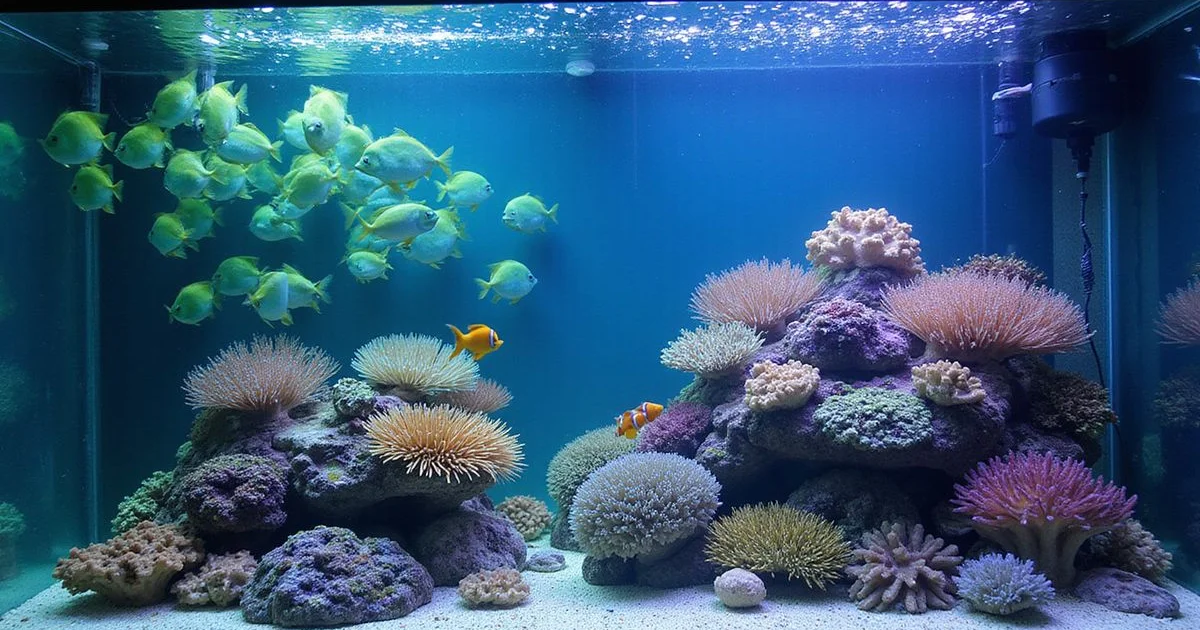
You know how one aggressive fish can ruin an entire tank setup. Our team sees this happen daily when buyers purchase juveniles without planning for their adult size. From what we observe, territory planning is the dividing line between a peaceful display and a chaotic one. Let us break down the exact data you need to build your own saltwater fish compatibility chart. This guide provides the practical facts required to stock your aquarium successfully.
How to read the chart
Our clients often ask how to decipher a marine fish compatibility chart. You are balancing four distinct factors in any setup.
A 2026 industry survey found that nearly 70% of aggression issues stem directly from poor territory planning. We always recommend visualizing your tank in three vertical zones. Top, middle, and bottom dwellers usually ignore each other completely. If you are also juggling reef compatibility, our reef-safe fish for beginners guide covers fish-to-coral safety alongside the fish-to-fish chart below.
Saltwater compatibility requires balancing:
- Aggression level at maturity (juveniles are misleading)
- Tank-size needs (tangs need swimming room, gobies do not)
- Territory overlap (similar species fight; dissimilar species ignore each other)
- Order of introduction (later additions face the territorial fish already in residence)
A compatible mix has low aggression overlap and enough tank size for everyone to claim territory.

Compatibility by group
Clownfish (Amphiprion)
You can keep one bonded pair per tank. Mixing species is a direct path to tank conflict.
Our aquarists prefer sourcing captive-bred options from facilities like ORA or Biota to ensure lower stress and better health.
- One bonded pair per tank, so never mix species like ocellaris, percula, and maroon
- Captive-bred ocellaris and percula are the most peaceful options
- Avoid maroon and tomato clowns in nano tanks; tomato clownfish grow up to four inches and get highly aggressive
- ORA Blood Orange hybrids offer a striking color alternative for 30-gallon tanks
- Compatible with: gobies, blennies, chromis, firefish, royal grammas, dottybacks
- Tank min: 20 gal (single), 30 gal (pair)
Gobies
Gobies are the most reef-safe and peaceful fish for your sand bed. Top choices include the yellow watchman, neon, clown, and diamond goby.
We recommend providing a substrate depth of two to four inches. Mix fine sand with coarse coral rubble so the burrows do not collapse.
- Most reef-safe and peaceful options include yellow watchman, neon, clown, and diamond
- One per species per tank, as same-species gobies fight
- Pair with a pistol shrimp for behavior interest; a Tiger Pistol Shrimp (Alpheus bellulus) is a tireless 3-inch excavator
- The goby acts as the lookout for the nearly blind shrimp in a classic commensalism partnership
- Compatible with: nearly everything peaceful
- Tank min: 10 gal (nano gobies), 20+ gal (larger species)
Blennies
Lawnmower, tailspot, midas, and bicolor blennies are all peaceful and reef-safe. These fish add massive personality as they perch on your rocks.
Our maintenance teams suggest holding off on lawnmower blennies until your tank is fully mature. Adding them to a brand new setup often leads to starvation due to a lack of microalgae.
- Lawnmower, tailspot, midas, and bicolor blennies are all peaceful and reef-safe
- One per species in small tanks; multiple species work fine in 75+ gal
- Require established tanks with plenty of natural grazing material
- Compatible with: clowns, gobies, firefish, chromis
- Tank min: 20 gal
Wrasses
Six-line wrasses are highly territorial. You must add them last to prevent severe bullying of new arrivals.
We rely on the $20 six-line wrasse for excellent pest control. They aggressively hunt flatworms and pyramidellid snails.
- Six-line: territorial; keep one per tank; excellent for pest control
- Fairy wrasses (flame, lubbock’s, scott’s): peaceful with most species
- The Lubbock’s fairy wrasse stays around three inches and thrives in 30-gallon setups
- Christmas wrasses: peaceful, captive-bred available
- Larger wrasses: not reef-safe; eat snails and inverts
- Tank min: 30-55+ gal depending on species
Tangs
You need at least a 75-gallon setup for a single tang. According to 2026 expert guidelines, a 100-gallon tank with a 6-foot length is required for a Yellow Tang to truly thrive.
Our installations always follow the rule of avoiding similar-bodied tangs. A yellow tang and a scopas tang will fight constantly.
- Need 75-gal+ for any single tang; 125+ gal for multi-tang setups
- Captive-bred Yellow Tangs from Biota arrive at 1.25 inches and are the most beginner-friendly
- Avoid mixing similar-bodied tangs (yellow and scopas tangs fight)
- Mix differently-shaped species: yellow + sailfin + naso works in 180+ gal
- Compatible with: clowns, gobies, blennies, wrasses (in adequate space)
- Tank min: 75 gal (single), 125+ gal (multi-tang)
Dottybacks
The Orchid dottyback, Pseudochromis fridmani, is captive-bred and quite peaceful. It adds a stunning flash of purple to your rocks.
We warn clients to be cautious with the Royal dottyback, Pictichromis paccagnellae. It is much more aggressive and mostly incompatible with shy fish.
- Orchid dottyback (Pseudochromis fridmani): captive-bred, peaceful
- Royal dottyback (Pictichromis paccagnellae): more aggressive, semi-incompatible with shy fish
- One per tank; highly aggressive against similar-bodied fish
Cardinalfish
Banggai and pajama cardinals are peaceful schoolers that add visual interest to the middle water column.
Our setups often feature a group of four to six cardinals in a 55-gallon tank.
- Banggai and pajama cardinals are peaceful schoolers
- Group of 4-6 in 55+ gal
- Sometimes hover in mid-water rather than schooling tightly
- Generally passive and safe alongside easily intimidated species
Firefish
Firefish are beautiful and extremely peaceful. They are also notorious jumpers.
You absolutely must have a tight tank lid to keep them inside the aquarium. Startling them causes a rapid upward darting motion.
- Beautiful, peaceful, but jumpy
- Tight-fitting tank lid required
- One per species per tank
- Compatible with: clowns, gobies, blennies, chromis, cardinals
Angelfish (most reef-incompatible)
If you want a truly reef-safe angelfish, look at the Genicanthus genus. Swallowtail angelfish are planktivores that ignore your corals entirely.
We advise strict caution with Centropyge dwarf angels like the coral beauty. They often nip at fleshy LPS corals and clam mantles.
- Centropyge dwarf angels (coral beauty, flame, rusty): “with caution” reef-safe
- Genicanthus (Swallowtail) angels are the only truly safe option for reefs
- Larger angels (queens, emperors, French): not reef-safe and need 180+ gal tanks
- One angel per tank generally
- Compatible with: tangs, wrasses, clowns (in larger tanks)
Sample stocking lists
Stocking a tank requires balancing bioload with actual swimming space. The marine fish compatibility matrix shifts completely depending on your total water volume.
Our technicians use the following proven combinations for different tank sizes. Each list accounts for mature adult sizes and proper territorial zoning.
| Tank Size | Stock |
|---|---|
| 20 gal nano | Ocellaris pair + yellow watchman goby + pistol shrimp + cleanup crew |
| 30 gal | Ocellaris pair + yellow watchman + lawnmower blenny + 4 chromis + cleanup crew |
| 55 gal | Ocellaris pair + diamond goby + tailspot blenny + 5 chromis + 2 firefish + 1 royal gramma + cleanup |
| 75 gal | All of 55 list + yellow tang + six-line wrasse + 4 banggai cardinals |
| 125 gal | All of 75 list + sailfin tang + flame angel + cleaner wrasse pair + foxface |
Order of introduction
The saltwater stocking order is just as crucial as the species you select. Each new fish faces existing residents that already hold territory.
Our standard protocol is to add the most peaceful fish first and the most aggressive species last. This precise sequence prevents dominant fish from monopolizing the entire tank.
- Cleanup crew (snails, hermits, cleaner shrimp) at week 6-8 cycle complete
- Peaceful first fish (clownfish pair) at week 8-10
- Gobies and blennies at week 12-14
- Chromis school and firefish at week 16-18
- Wrasses, dottybacks, royal grammas at week 20-24
- Tangs (in big tanks) at month 6+
- Centerpiece angels at month 9+
The pattern remains simple. Adding the most aggressive species last prevents them from terrorizing new arrivals.
When to come in
We cross-check every saltwater fish purchase against your existing stock and tank size. Bring your tank info, including total gallons, current livestock, and the age of the build.
Our experts will vet the new fish for compatibility before bagging them up. Browse the saltwater hub for current stock and availability.