
Why Florida changes acclimation
We know the challenges of fish acclimation Florida summer weather brings, especially when July heat indexes regularly hit 103°F to 110°F. Standard advice says to simply float the bag in your tank for 15 minutes to match the temperature.
We know that basic method works fine when transport weather stays around a mild 68°F. The problem arises when a 30-minute drive home in a Sarasota summer turns your vehicle into an oven.
Our team routinely monitors car interior temperatures, and they can easily spike to 140°F during midday errands. This intense heat causes a rapid, lethal chain reaction inside the transport bag. We must account for the fact that ammonia toxicity increases exponentially when water temperature rises.
The bag itself becomes the killer.
We are going to break down exactly how this climate impacts your marine livestock. This guide will walk you through our exact protocol for safe summer transport and proper drip acclimation. We will share the specific tools and timing needed to get your fish into your tank alive and healthy. Acclimation is the second screen on a long disease defense — our 2-week quarantine protocol guide covers the first.
The fish acclimation Florida summer protocol
We strictly enforce a comprehensive temperature control strategy before a fish ever leaves the store. Transporting livestock safely requires planning your vehicle environment and limiting exposure time.
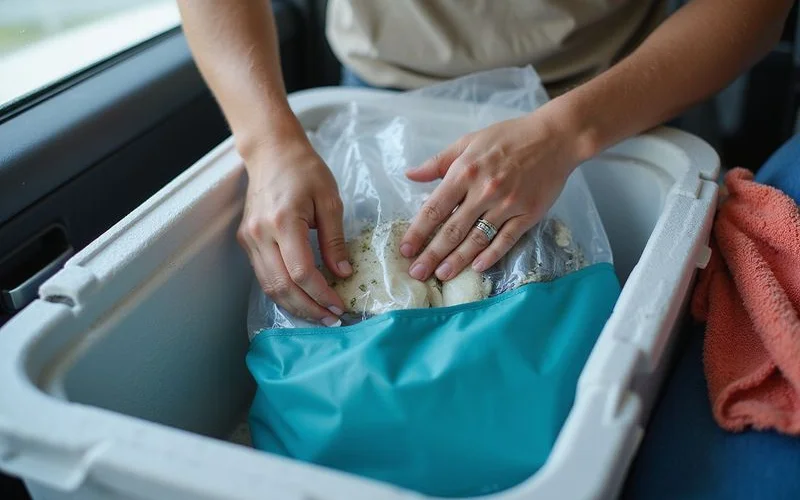
Our preferred method starts with an Expanded Polystyrene (EPS) cooler to provide superior insulation against ambient heat. You need to create a dark, climate-controlled micro-environment for the drive.
We highly recommend adding a drop of an ammonia neutralizer like Seachem AmGuard if a delay occurs. This chemical addition keeps ammonia in a non-toxic state while the fish breathes heavily in transit.
Pre-Transit and Store Procedures
We require all customers to prepare their vehicles before arriving for a pickup. A cool car interior is your first line of defense against thermal shock.
Before you arrive at the store:
- Run the AC in the car to get it cold first.
- Have a styrofoam EPS cooler ready in the back seat.
- Bring a dark towel or use the cooler lid to block sunlight.
We bag every summer purchase with extra pure oxygen and wrap it in heavy brown paper. Thermal transfer slows down significantly when the bag is properly shielded from direct light.
At the store:
- We will bag your new fish with extra oxygen for the trip.
- Paper wrapping blocks light and creates a small thermal barrier.
- Place the bag inside the closed cooler instead of on an open seat.
Driving and Arrival Rules
Our team considers traffic delays to be the biggest threat during summer transit. Total transit time must remain under 45 minutes to maintain safe oxygen levels.
On the drive:
- Keep the AC running with cool air directed at the cooler.
- Drive directly to your home or business.
- Avoid making any extra stops or running errands.
We advise leaving your display tank lights completely off for the first 12 to 24 hours. A dark tank prevents existing fish from immediately harassing the new arrival.
Arrival:
- Keep the tank lights turned off.
- Float the closed bag in the tank for 15 minutes for temperature matching only.
- Open the bag, set up drip tubing, and drip-acclimate over 45 to 90 minutes.
- Net the fish out of the bag to release it into the tank.
- Never pour the transport bag water into your display tank.
Drip acclimation, step-by-step
We consider slow drip acclimation the only acceptable method for how to acclimate saltwater fish. Precision is critical because a fast salinity change will shock and potentially kill your new pets.
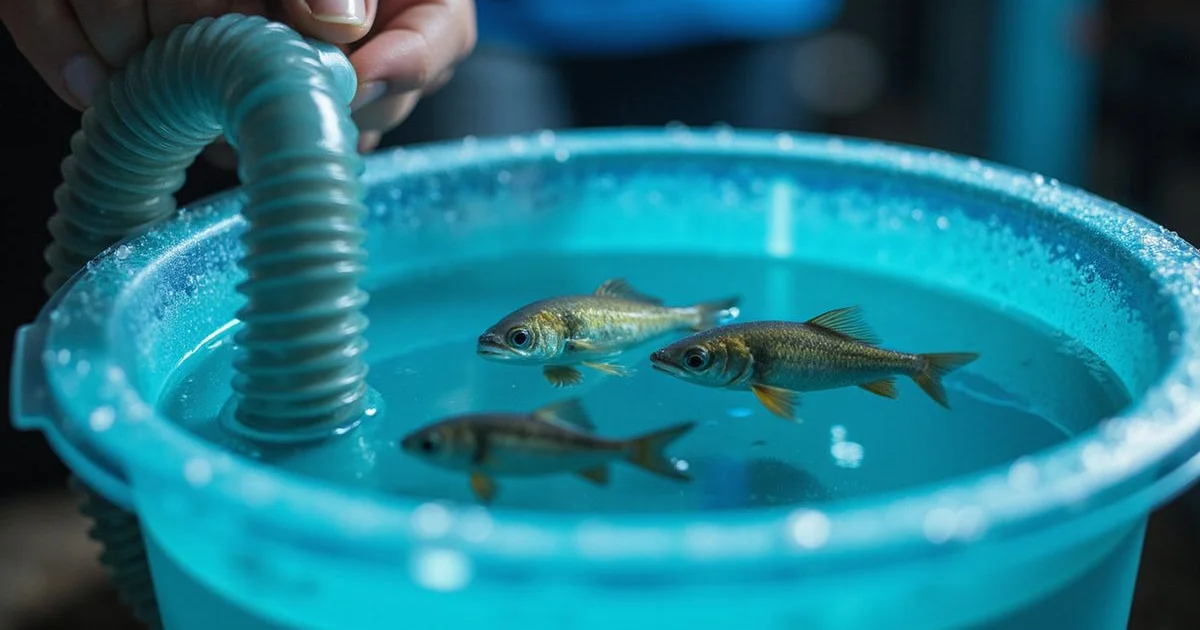
Our technicians prefer using a dedicated kit like the Innovative Marine AccuDrip or the Bubble Magus Drip Acclimation Kit. These specialized tools feature a siphon-starting hand pump and a control valve to prevent messy spills.
We set the control valve to deliver a very slow and steady flow. The goal is to gradually equalize the water chemistry over an hour without stressing the animal.
| Acclimation Method | Flow Control | Siphon Start | Precision Level |
|---|---|---|---|
| Standard Airline Tubing | Manual knots | Mouth suction (High risk) | Low to Moderate |
| Premium Drip Kit (e.g., AccuDrip) | Dial valve | Hand pump (Clean) | High |
The Step-by-Step Drip Process
We recommend dedicating a small, clean bucket specifically for this procedure. Cross-contamination from household cleaning buckets can introduce lethal toxins into your system.
- Pour the bag contents (fish plus bag water) into a small, clean bucket.
- Set up an air-line tubing siphon from your tank to the bucket.
- Tie a knot in the tubing or use a control valve to slow the drip rate to 2 to 4 drops per second.
- Drip until the bucket water doubles in volume (about 30 minutes).
- Pour off half the bucket water down the drain, never into your display tank.
- Continue dripping for another 30 to 45 minutes.
- Test the salinity to ensure it matches your tank within 0.001 specific gravity.
- Net the fish gently and place it into the tank.
- Discard all remaining bucket water.
Our standard target is to match the tank’s specific gravity perfectly, usually aiming for a stable 1.025 to 1.026. A close match ensures the fish can process oxygen efficiently in its new home.
We budget 60 to 90 minutes for fish, and even longer for sensitive corals or invertebrates. Rushing this final step ruins all the careful transport work you just completed.
When the bag arrives hot
We treat a hot transport bag as an immediate aquatic emergency. Action must be taken quickly if you get stuck in traffic and the bag feels warm to the touch, generally anything over 78°F.
Our strict rule is to never float a hot bag in your display tank. Floating a bag that is already sitting at 85°F will essentially cook the fish before it can acclimate.
We start the drip acclimation process immediately in a separate container instead. An external cooling method is required to bring the temperature down safely.
Cooling a Hot Transfer
We suggest placing a small ice pack against the exterior of the acclimation bucket. Directing a fan over the water surface also helps lower the temperature through evaporative cooling.
We never add ice directly into the bucket because it alters the salinity and introduces tap water chemicals. The focus must be on a gradual, controlled temperature drop.
- Do not float the hot bag in your tank.
- Open the bag immediately and begin the drip acclimation process.
- Add a small ice pack to the bucket exterior to slowly drop the temperature.
- Watch the fish closely for signs of distress.
Our staff closely monitors the gills of any heat-stressed fish. Rapid gasping at the surface indicates severe oxygen depletion and high ammonia exposure.
We prioritize getting a gasping fish into the main tank over waiting for a perfect salinity match. You should skim off the bag water and use only your tank water for the final five minutes if this emergency transfer is necessary.
Holding fish for evening pickup
We gladly hold purchases in our quarantine system to combat Florida heat livestock dangers. High noon in Florida brings brutal temperatures that easily overwhelm standard packaging.
Our team routinely delays pickups until the evening when the intense heat finally breaks. Temperatures drop, traffic clears out, and the transit route becomes significantly safer for sensitive livestock.
We do not consider this holding service a special favor to our customers. This precaution is simply how a professional service team keeps livestock alive during a harsh Florida summer.
When to come in
We strongly recommend scheduling your summer pickups for the early morning or late evening hours. Mid-afternoon car interiors regularly hit 130°F even with the air conditioning running at full blast.
Our scheduling system is designed to help you completely avoid that dangerous midday window. The saltwater room and the coral pickup desk operate using this exact same temperature protocol.
We will carefully bag your livestock and time the transfer to perfectly match your specific transit conditions. Proper planning ensures your investment survives the trip from our tanks to yours.
We look forward to helping you schedule your next safe, climate-controlled pickup to master fish acclimation Florida summer conditions. Please call our shop today to reserve your morning or evening collection time.