
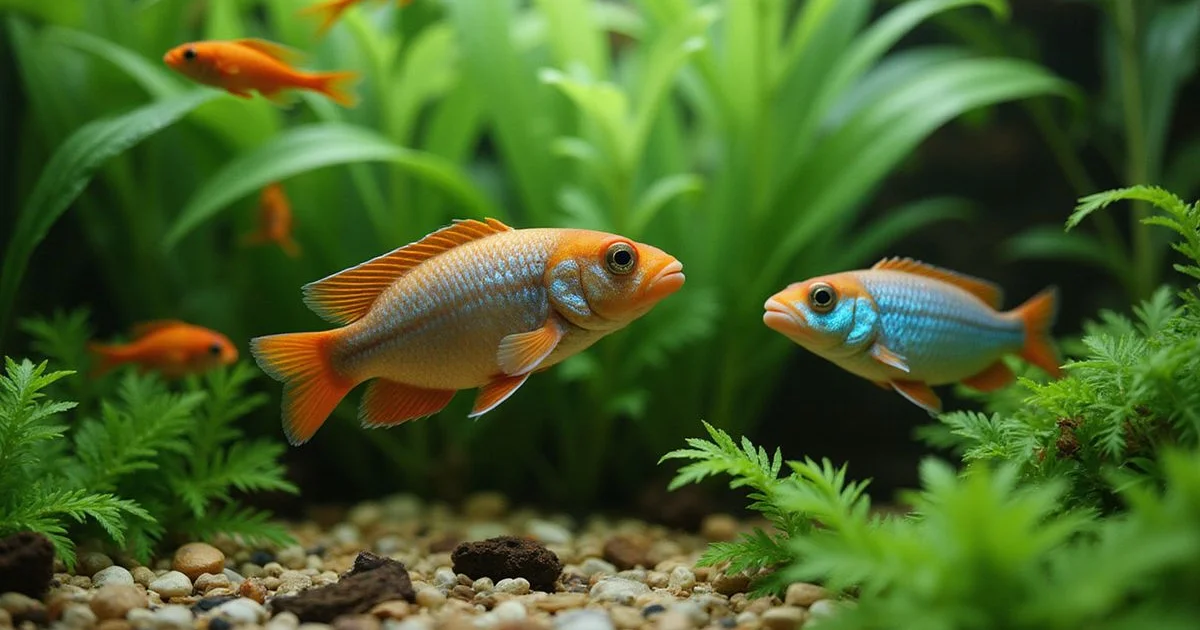
What “peaceful” actually means
Our professional maintenance teams define “peaceful” in the cichlid family as a species that claims a tiny footprint, like a single cave, rather than the entire aquarium. These specific dwarf species ignore non-cichlid tankmates outside of short-term spawning squabbles.
Sourcing peaceful cichlids for community tank setups is the best way to avoid a stressful, aggressive environment. Browse our cichlids selection in store — we tag temperament so beginners can identify the genuinely community-safe species at a glance, and our cichlid tank setup and aggression management guide explains the rockwork tricks that keep even the calmer species honest.
“We see the same stocking mistakes every week in display tanks across the US.”
Most standard cichlids defend massive territories during breeding cycles. Plan your gallon capacity and dither species accordingly to keep the peace.
We want to share the exact fish that actually work in a mixed environment. Let the data guide your next aquarium purchase.
Choosing these reliably community-safe options completely eliminates the guesswork.
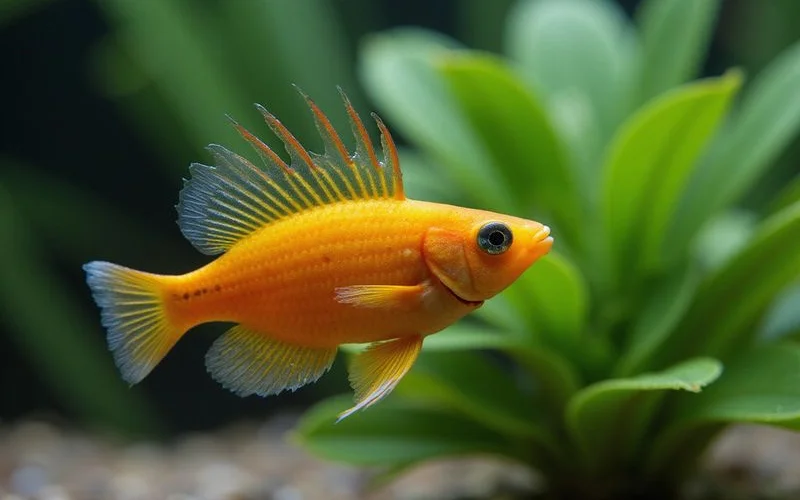
Reliably community-safe options
We rely on a specific list of dwarf cichlids community combinations that consistently succeed. The options below are proven to be peaceful when given the correct water parameters and tank size.
Review the temperature and pH requirements before making your final selection.
Bolivian Ram (Mikrogeophagus altispinosus)
Our top recommendation for a beginner-friendly dwarf cichlid is the Bolivian Ram. This sturdy fish usually lives four to six years and stays under three inches in length.
Provide fine pool filter sand because they naturally sift substrate through their gills to find food. We find they handle standard community water temperatures of 72 to 79 degrees Fahrenheit perfectly.
Their subtle red and blue fins look stunning against green aquarium plants. This impressive temperature tolerance gives you dozens of compatible tank mate options.
Keyhole Cichlid (Cleithracara maronii)
Our clients love the Keyhole Cichlid for its incredibly gentle personality. Reaching about four to five inches long, this oval-shaped fish rarely bothers anyone.
The distinct black spot on their side sometimes extends into a shape resembling an old-fashioned keyhole. We often pair them with active dither fish like tetras to coax them out of hiding.
When startled, a Keyhole can rapidly darken its colors to blend into the shadows. Keep them in groups or pairs in a tank of at least 30 gallons to reduce their natural shyness.
Apistogramma cacatuoides (“Cockatoo”)
We stock the Apistogramma cacatuoides because it handles harder tap water, like what is found in Sarasota, better than most dwarf species. The Triple Red variant is a massive favorite in the US market.
You can typically find healthy, tank-bred males for about 15 to 35 dollars. Our suggested setup for a bonded pair includes a 20-gallon tank with plenty of broken terra cotta pots.
Use these pots to create secure spawning caves for the female. The male will display gorgeous fin extensions while guarding the immediate area around the nest.
Apistogramma agassizii
Our more experienced customers often gravitate toward the flashy Apistogramma agassizii. This species features a distinct, spade-shaped tail and brilliant lateral lines.
They require soft, slightly acidic water with a pH resting between 5.5 and 7.0. We strongly advise keeping their nitrate levels strictly under 30 ppm.
Perform regular water changes to prevent stress and disease in these sensitive fish. Spawning aggression is a real factor, so provide plenty of visual barriers using driftwood.
Kribensis (Pelvicachromis pulcher)
Our team considers the Kribensis to be the ultimate West African dwarf cichlid. These energetic fish thrive in a pH of 6.0 to 7.0 and readily accept standard community diets.
Watch for the female to develop a brilliant cherry-red belly when she is ready to breed. We warn every buyer that a breeding pair of Kribs will aggressively defend the bottom half of a tank.
They are shelter breeders that will lay up to 300 eggs inside a single cave. Upgrading to a 30-gallon tank provides enough space for top-dwelling tetras to escape the angry parents.
German Blue Ram (Mikrogeophagus ramirezi)
Our strict rule for German Blue Rams is that they require a dedicated, high-temperature setup. They need stable water between 82 and 86 degrees Fahrenheit to survive.
Keeping the heat high prevents common ailments like Ich and keeps their immune system strong. We see many beginners accidentally kill these stunning fish by dropping them into an unheated 72-degree tank.
Pair them exclusively with heat-loving species like Sterbai corydoras or Cardinal tetras. A healthy German Blue Ram usually lives for two to three years in pristine conditions.
Sample stocking lists
Our daily logs show that proper stocking levels prevent endless territory disputes. Planning your exact community list before visiting the store saves time and money.
A well-balanced aquarium provides a stunning, low-maintenance display for your living room or office. We designed these four templates based on the most successful tanks in our service route.
Review the table below to match your gallon size with a compatible species list. These specific combinations ensure every fish has the right temperature and swimming space.
| Tank | Stock | Optimal Temperature |
|---|---|---|
| 29 gal | Bolivian Ram pair + 8 cardinal tetras + 6 corydoras + bristlenose pleco | 76-79°F |
| 40 gal | Apisto cacatuoides trio + 10 rummynose tetras + 6 sterbai cory + 5 amano shrimp | 78-80°F |
| 55 gal | Pair of Keyholes + Apistogramma trio (different territory) + 12 ember tetras + 8 cory cats + bristlenose | 76-80°F |
| 75 gal | Multi-species community: Bolivian Ram pair + Kribensis pair + Apisto pair + tetra schools + cory cats | 77-79°F |
What NOT to mix
We constantly rescue standard community tanks that were destroyed by the wrong cichlid choices. Big box stores across the US sell juvenile Oscars at just two inches long.
Avoid buying them for a community, as they grow an inch a month and quickly exceed 12 inches. We also refuse to mix Convict cichlids into peaceful setups.
Convicts breed non-stop and will fiercely terrorize any fish that crosses their path. Keep these specific fish in species-only or biotope tanks to ensure a high success rate:
- Mbuna and most African Rift cichlids, which are way too aggressive and need hard water with rock-only setups.
- Oscars, Jack Dempsey, and Texas cichlids, which are highly predatory and get far too big.
- Convicts, which endlessly claim territory, dig up substrate, and breed aggressively.
- Wild-caught Discus, which are soft-water specialists with strict parameter needs.
- Salvini and large Severums, which will quickly outgrow community tanks.
When to come in
We ensure every dwarf cichlid is eating and healthy before it leaves the store through our strict quarantine process. Call ahead to check the current stock of Bolivian Rams, Apistos, Keyholes, and Kribensis.
These popular community-friendly cichlids sell out incredibly fast during the weekend rush.
We will cross-check your existing community before bagging to avoid stocking surprises.
The community compatibility guide covers the rest of the planning. Stop by the shop today to find the perfect centerpiece fish for your aquarium.