
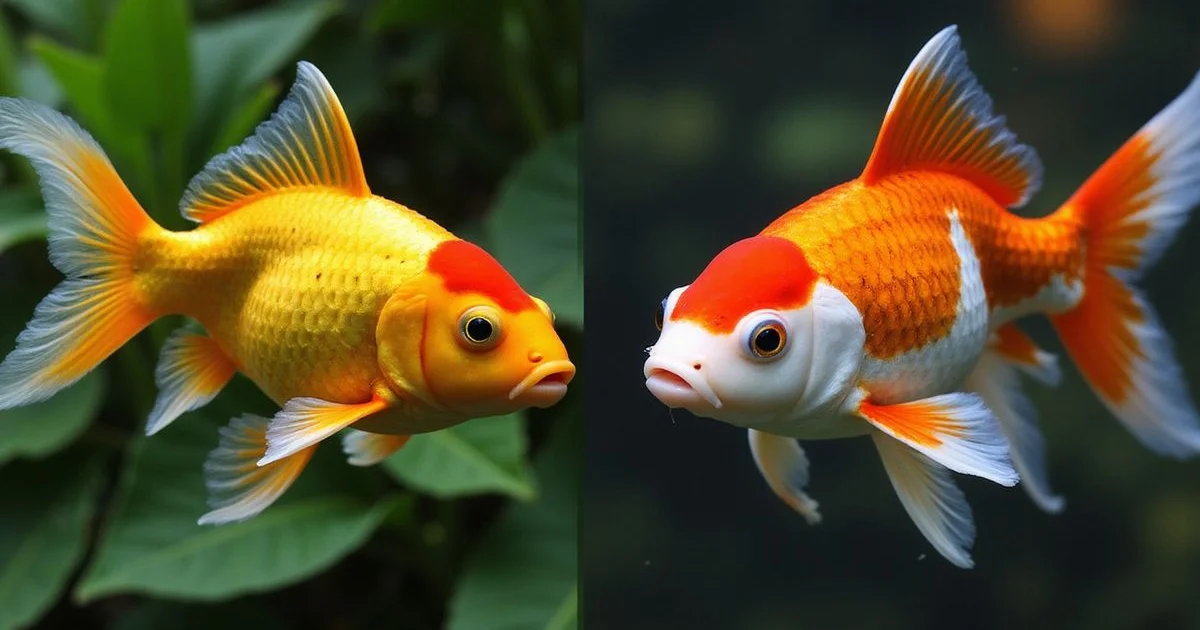
The short answer
Pick goldfish if your pond holds under 500 gallons, your budget is tight, or you want low-fuss color. Go with koi if you have at least 1,000 gallons, three feet of depth, and you want large fish you can hand-feed.
Our team sees homeowners frequently misjudge their water volume.
A 500-gallon feature is perfect for comets, but koi outgrow small ponds quickly and stress out in shallow water once summer hits. Comet goldfish and shubunkin hit a sweet spot for smaller spaces without sacrificing bright color. See pond fish for Sarasota for what survives our specific climate, and check our goldfish and pond fish in stock for current livestock.
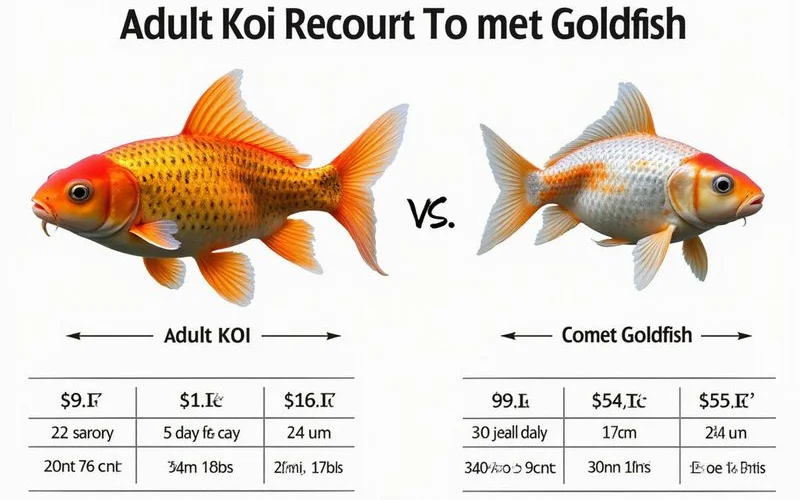
Quick head-to-head
The table below lines up the two most common outdoor pond options. We picked comet goldfish for the goldfish column because they are the right variety for a sunny climate. Fancy goldfish simply do not belong in an open Florida pond.
Our local ecosystem demands hardy species that handle temperature swings. Both fish thrive in an ideal water temperature of 65°F to 75°F, but their space requirements differ wildly.
| Aspect | Comet goldfish | Koi |
|---|---|---|
| Adult size | 10 to 12 inches | 18 to 24 inches plus |
| Lifespan | 10 to 20 years | 30 to 40 years |
| Pond volume per fish | 50 to 75 gallons | 250 gallons or more |
| Minimum depth | 2 feet | 3 to 4 feet |
| Ideal pH range | 6.5 to 7.5 | 7.5 to 8.0 |
| Estimated pond build cost | $800 to $2,000 | $5,100 to $15,875 |
| Filtration needs | Standard | Oversized, with UV sterilizer |
| Heron risk | High | Lower at depth |
| Best for | Small to mid backyard ponds | Large, deep display ponds |
Goldfish: low-fuss color for smaller ponds
Comet goldfish and shubunkin are the workhorses of the Florida backyard water feature. They grow to 10 to 12 inches, tolerate our heat well, and adapt to almost any pond shape.
A single-tail goldfish is built for sustained swimming. This is exactly what you need in a sunny environment with strong water circulation.
Practical benefits of smaller species
Two practical benefits make this choice easy for many property owners. First, a standard 250 to 500-gallon pond provides a perfectly stable environment for a small school.
Our customers frequently install a working comet pond for under $1,500 using a pre-formed liner and a standard pump. You avoid the massive budget pressure of a full ecosystem installation.
The trade-offs involve physical presence and predator vulnerability.
We always warn clients that these smaller fish are much harder to hand-feed than their larger cousins. They also become quick targets for great blue herons in shallow water.
A 1-3/4 inch heavy-duty knotted nylon net stops birds from wading in without ruining your view.
Goldfish work best when:
- Your pond holds under 500 gallons.
- The maximum depth is two to three feet.
- The build budget sits under $2,000.
- Kids will be feeding and watching the water feature.
- You want bright color like Sarasa comets without hunting for expensive named varieties.
Koi: big fish, big build
Koi are the headline pond fish because they grow up to 24 inches, live for 30 to 40 years, and feature colors you can collect like art. A mature setup is a major property feature, not just a corner of the yard.
That presence comes with strict mechanical and spatial requirements. These fish need massive volume, deep water, and serious commercial-grade filtration.
Plan for at least 1,000 gallons for a small group. You will need three to four feet of depth for predator safety and proper summer cooling.
Essential equipment for large setups
Filtration requirements scale up dramatically with fish size. A standard clarifier will not prevent disease or handle the heavy bioload.
Our standard recommendation is a high-end UV sterilizer, like those from Aqua Ultraviolet or Matala. You must run these units at 30 watts per 1,000 gallons for true parasite sterilization.
We see many owners fail by not matching their pump’s flow rate to the sterilizer. Pushing water too fast causes the contact time to drop below the lethal threshold for pathogens.
This renders the expensive UV unit completely ineffective. Costs spread across a much wider range than smaller features.
Our data shows a quality US installation costs between $5,100 and $15,875. The bulk of that budget goes toward excavation and the filtration ecosystem.
Koi work best when:
- The pond holds 1,000 gallons or more.
- You can run aeration and filtration year-round.
- You want fish that learn to interact with you at the surface.
- The installation budget comfortably exceeds the average of $5,100.
- You want to collect named patterns like Kohaku, Sanke, and Showa over time.
Mixed ponds: when both make sense
A mixed pond works well if you size the environment for the largest inhabitants first. Comets and shubunkin live happily alongside larger species if the space supports the heavier bioload.
Our favorite approach is to maintain a stable water temperature between 65°F and 75°F. Both species hit peak metabolic activity in this range and share basic dietary needs.
They will readily accept the exact same water parameters.
Key rules for a mixed setup:
- Split the feeding zones: Drop floating pellets for the large eaters and sinking pellets in a different spot so smaller comets get a meal.
- Skip the fancy breeds: Round-bodied varieties like orandas and ranchus feature heavy hood growth over their eyes.
- Factor in speed: Fancy breeds are far too slow to compete at feeding time and become easy targets for predators.
If you are still weighing outdoor stock against an indoor setup, our goldfish tank requirements guide covers indoor minimums by specific breed.
Picking by your real situation
Most decisions come down to three honest questions about your property constraints. Walk through them in order before you fall in love with a specific specimen at the store.
- How many gallons do you actually have? Measure length by width by average depth in feet, then multiply by 7.48 to get your total gallons. Under 500 gallons points to small species. Over 1,000 points to large ones, while the middle is a judgment call.
- How deep can you go? Two feet is perfectly fine for comets. Larger species need three to four feet with steep drop-offs for heron safety and adequate summer cooling.
- What is the build budget? A large ecosystem demands stronger filtration, more aeration, and commercial UV sterilizers. Standard koi pond construction averages over $10,500 in the US, while a small water feature kit costs around $800.
Honest budgeting up front prevents heartbreak later. If those three answers all point one way, your choice is already made.
Our crew always recommends starting small if the answers conflict. You can always upgrade the equipment and graduate to larger fish later.
Going the other direction is incredibly frustrating.
Florida realities to plan for
Our regional climate dramatically shapes both of these outdoor options. Summer water temperatures climb fast in shallow environments.
Water above 80°F holds significantly less dissolved oxygen than cooler water.
We strongly advise adding supplemental aeration, as it is not optional for either species. Shade from water lilies or a partial pergola structure helps control both the heat and aggressive algae blooms.
Local predator management
Predators remain a constant threat in our specific area. Great blue herons, raccoons, and the occasional river otter are all active hunters.
Great blue herons will happily wade into water up to two feet deep to hunt.
Our best defense strategy relies on deeper water and steep pond edges. Heavy-duty netting during heron migration also reduces your daily losses.
Larger fish survive this predator pressure better simply because they outgrow the heron’s preferred bite size.
When to come in
We carry pond livestock seasonally, typically running from March through October. Stock rotates fast, especially for named-pattern koi and the brighter shubunkin varieties.
Our holding tanks empty quickly when new shipments arrive. Call ahead to confirm what is swimming before you make the drive.
Bring your rough pond dimensions and a recent water test if you have one.
Our specialists will help you match species to the actual space and talk through any filtration gaps.
Our standard quarantine process:
- Strict isolation: All new arrivals sit in a dedicated tank for 14 days.
- Parasite elimination: The holding tanks utilize a 0.3% salt solution.
- Health verification: Staff monitors every fish for pristine health before release.
You can safely take your selections home once they clear this process. See the goldfish and pond fish in stock page for our current selection.